When developing an automated abrasive blast finishing process, an important early consideration is whether the application can be addressed using a proven automation system or requires a more specialized, custom-engineered solution.
 These aren’t necessarily two completely different approaches.
Empire Abrasive Equipment uses proven automation concepts as engineering foundations that can be configured around specific production requirements. When an application demands something different, those same technologies and engineering principles can be adapted or combined to create a custom system.
The objective is not to make an application fit a predetermined machine. It is to determine the most effective way to control part movement, blast-nozzle movement, media delivery, recovery, and production flow.
Starting With Proven Automated Blast Finishing Systems
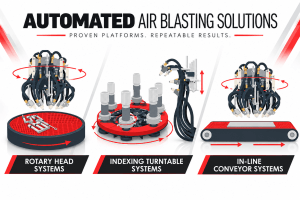
Many applications can be addressed using one or a combination of Empire’s three core automated air-blasting system concepts:
Each provides a proven method for controlling how parts and blast nozzles interact.
A Rotary Head Blast Finishing System uses multiple blast guns arranged around a rotating head to create multiple angled blast streams and provide broad, consistent coverage.
An Indexing Turntable Blast Finishing System moves parts through dedicated processing positions and can combine loading/unloading, blasting, blowoff, part rotation, and other functions within a coordinated production cycle.
An In-Line Conveyor System moves parts continuously through the blasting operation and can integrate the blast process with upstream or downstream manufacturing equipment.
These concepts provide starting points. The complete system is then configured around the requirements of the application.
Configuring the System Around the Part & Application
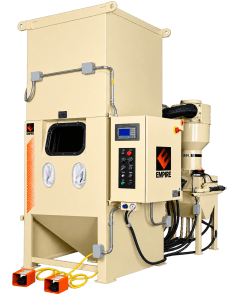 Even when a proven automation concept provides the foundation, the finished equipment can incorporate significant application-specific engineering.
An Indexing Turntable System, for example, can be configured with multiple rotating part stations, precision indexing, recipe storage, automatic media replenishment, programmable nozzle oscillation, and other process controls.
Rotary Head technology can be incorporated into batch, continuous-table, or in-line configurations, with the equipment designed around the required part movement and production process.
In-Line Systems can be engineered with material-handling methods suited to the workpiece and can transfer parts directly into subsequent manufacturing operations.
Batch and cell machines can also incorporate different automation concepts and combinations of part and nozzle manipulation. The machine configuration is selected around the process rather than treated as a separate automation method.
Other system decisions can include pressure or suction media delivery, media recovery, loading and unloading, controls, and integration with surrounding manufacturing equipment.
For many applications, this approach provides the required automation while taking advantage of proven equipment concepts and technologies.
When Does an Application Require a Custom Solution?
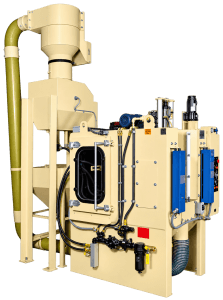 Some manufacturing processes simply don’t fit neatly within an established system configuration.
The workpiece may have an unusual geometry. The required movement may be unconventional. Internal surfaces may need to be blasted. Parts may need to transfer directly from another piece of equipment. Multiple functions may need to occur within the same system. Or the production line may impose unique space and material-handling requirements.
In these situations, Empire can combine different methods of nozzle manipulation, part manipulation, and material handling to develop a process specifically for the application.
Empire’s automation experience includes specialized approaches involving rotary lances, pinch-belt conveyors, cable and tube handling, plate-processing systems, specialized indexing arrangements, and other application-specific designs.
The common denominator is that the equipment is engineered around how the workpiece needs to move through—and interact with—the blast process.
Custom Doesn’t Necessarily Mean Starting From Scratch
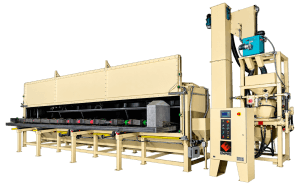 A custom system can still draw heavily from proven Empire technology.
For example, an application may use an established method of part handling combined with a specialized nozzle-manipulation arrangement. Another might adapt a proven automation concept to accommodate unusual workpiece geometry or integrate blasting with another production operation.
This approach allows established components, technologies, and operating concepts to be applied in new ways.
As a result, the question isn’t necessarily:
“Do we need a standard machine or a custom machine?”
A better question is:
“How much application-specific engineering does this process require?”
Questions That Drive the Design
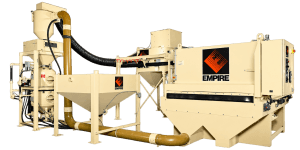 Before determining the system architecture, Empire needs to understand the complete process.
Important considerations include:
- What are the part dimensions and geometry?
- Which surfaces require blasting?
- What finish or surface condition is required?
- How should the part be held or transported?
- Does the part need to rotate or otherwise move during blasting?
- How should the blast nozzles move relative to the part?
- What production rate is required?
- Is production batch, continuous, or in-line?
- What media and blast-delivery method are required?
- How will abrasive be recovered?
- What happens immediately before and after blasting?
- Does the system need to communicate or physically interface with other production equipment?
The answers help determine whether a proven automation system can be configured for the application, whether multiple automation concepts should be combined, or whether a more specialized solution needs to be engineered.
Engineering the Process, Not Just the Machine
Automated abrasive blasting works best when the equipment is designed around the complete manufacturing process.
Sometimes that means configuring a Rotary Head, Indexing Turntable, or In-Line Conveyor System around the application. Other times it means incorporating those technologies into a batch or cell machine, combining established automation concepts, or developing a more specialized custom solution.
In every case, the starting point is the same: understand the workpiece, the required finish, the production requirements, and how the part needs to move through the blasting process.
From there, Empire can develop the appropriate combination of part handling, nozzle manipulation, media delivery, recovery, controls, and system integration to create an automated blasting solution engineered around the application.
Contact Us to discuss your requirements for a Custom Engineered Abrasive Blast System