Once a manufacturer determines that an abrasive blast finishing process should be automated, the next question is: What type of automated system is the best fit?
There is no single approach that works for every blast finishing application. Part geometry, production volume, required blast coverage, part handling, surface finish, and the way components move through production all influence automation system design.
Empire Abrasive Equipment uses several proven automation concepts as the foundation for engineered air-blast systems. Three core approaches—Rotary Head Blast Finishing Systems, Indexing Turntable Blast Finishing Systems, and In-Line Conveyor Blast Finishing Systems—provide different ways to control the relationship between the workpiece and blast stream. Understanding how each operates provides a useful starting point for evaluating an automated blasting application.
Rotary Head Systems
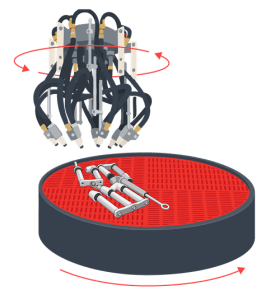 Rotary Head Air Blast Systems use multiple blast guns positioned around a rotating head to create multiple angled blast streams. As the blast head rotates, the workpiece is presented beneath the blast streams on a rotating table to provide broad, consistent coverage across all parts.
Empire Rotary Heads can incorporate six or nine blast guns, and both rotary-head speed and workpiece movement can be adjusted to suit the process.
The concept can also be incorporated into different production arrangements.
Batch Systems can use a rotating table beneath the Rotary Head to process parts within an enclosed machine.
Continuous Table Systems allow parts to be loaded and unloaded as the table rotates through the blasting area.
In-Line configurations can move parts beneath the Rotary Head on a variable-speed conveyor, allowing the blasting operation to become part of a continuous production process.
This flexibility makes the Rotary Head concept particularly useful when multiple angled blast streams and consistent surface coverage are important to the application.
Indexing Turntable Systems
 Indexing Turntable Systems use an indexing table to move parts through dedicated processing positions.
A typical system can include stations for loading/unloading, blasting, and blowoff. While parts are being blasted inside the enclosure, another station can be accessible for loading or unloading, helping maintain an efficient production cycle.
Parts can be mounted on individual fixtures that rotate during blasting, exposing the required surfaces to the blast stream. Depending on the application, the blast nozzles can also be manipulated to provide the necessary coverage.
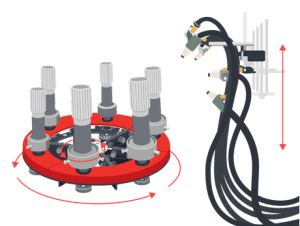 Indexing systems can incorporate features such as:
- Multiple rotating part stations
- Programmable vertical nozzle oscillation
- PLC and HMI controls
- Recipe storage
- Automatic media replenishment
- Precision indexing
- Light curtains and other safety systems
The result is a repeatable sequence in which part handling, blasting, and other process functions can occur within a coordinated automated cycle.
In-Line Conveyor Systems
For continuous or higher-throughput production, abrasive blasting may need to become part of the manufacturing line itself.
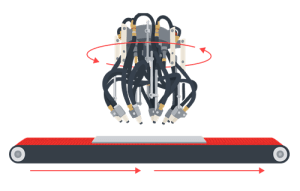 In-Line Conveyor Systems move workpieces continuously through the blasting operation rather than processing individual batches. Blast nozzles are positioned and controlled along the processing path to provide the required coverage as the parts move through the system.
The material-handling method can be engineered around the workpiece and application. Parts can travel through the blast zone and, where required, transfer directly into the next manufacturing operation.
This approach can be particularly useful when:
- Production is continuous
- Parts are already moving through an automated manufacturing process
- Consistent part presentation can be maintained
- Blasting needs to integrate with upstream or downstream equipment
- Production requirements favor continuous processing over individual batch cycles
An In-Line System therefore does more than automate the blasting operation—it can integrate abrasive blasting into the larger production process.
How Do Batch and Cell Machines Fit In?
An important distinction is that the physical machine configuration and the automation method are not necessarily the same thing.
Batch and cell machines can incorporate different methods of part manipulation and nozzle manipulation depending on the application. For example, a machine might use rotating work fixtures, automated nozzle movement, a Rotary Head, or a combination of movements to achieve the required blast coverage.
This gives Empire flexibility to apply proven automation concepts within a machine configuration appropriate for the customer’s production requirements.
Rather than selecting a machine based solely on a category name, the better approach is to determine how the part needs to interact with the blast stream.
What Determines the Right System?
Selecting the appropriate automation approach starts with understanding the part blasting application.
Important questions include:
- What is being blasted?
- Which surfaces need to be treated?
- What finish or surface condition is required?
- How should the part be presented to the blast stream?
- Does the part need to rotate or otherwise move during blasting?
- Should the blast nozzles move?
- What production rate is required?
- Is production batch or continuous?
- How will parts be loaded and unloaded?
- Does the blast process need to integrate with another manufacturing operation?
- What level of process control is required?
The answers help determine not only which automation concept makes sense, but also how it should be incorporated into the complete system.
The System Concept Is the Starting Point
Choosing a Rotary Head, Indexing Turntable, or In-Line Conveyor approach does not necessarily define the finished machine.
Instead, it establishes the basic relationship between the workpiece, material handling, and blast stream. Part fixtures, nozzle configuration and movement, media delivery, recovery, controls, safety systems, and other functions can then be engineered around the application.
And some applications won’t fit neatly into any one approach. In those situations, Empire can combine proven automation technologies or develop a more specialized custom solution.
The objective is not to fit the customer’s process into a predetermined machine. It is to understand what needs to be blasted, how it needs to be handled, and how the blast stream needs to reach it—and then build the automated process around those requirements.
Contact Us if You Are Considering Automation for Your Abrasive Blasting Project