Automation can transform abrasive blasting from a manual operation into a controlled, repeatable production process. But what actually makes a blast system “automated”?
At its simplest, an automated abrasive blast system allows the operator to load or introduce the part, initiate the cycle, and let the equipment perform the defined blasting process. Depending on the application, automation can control how the blast nozzles move, how parts are positioned or transported, blast duration, media delivery, blowoff, and other process functions.
For manufacturers evaluating ways to improve productivity and process consistency, understanding the different methods of automation is an important first step.
Why Automate Abrasive Blasting?
Manual blasting provides flexibility and remains an effective solution for many applications. However, applications involving higher production volumes, demanding quality requirements, or repetitive processes may benefit from automation.
Depending on the application and system configuration, automated blasting can help manufacturers:
- Improve product quality and consistency
- Increase production rates
- Reduce process variability
- Improve manufacturing flexibility
- Reduce manual processing requirements
- Control media consumption
- Improve worker safety
- Collect useful production and process data
- Reduce waste and manufacturing costs
The objective isn’t simply to eliminate manual labor. A properly designed automated system creates a controlled process in which the equipment consistently performs the movements and functions required to produce the desired result.
Two Fundamental Elements of Air Blast Automation
One of the most important concepts in automated blasting is the relationship between the blast nozzle and the workpiece. Automation can generally involve one or both.
Nozzle Manipulation
The blast nozzle or nozzles can be moved in a controlled pattern while the part remains stationary or follows a separate movement. Depending on the system, this movement may be created using rotary heads, oscillators, linear devices, robotic systems, or other mechanisms. Controlled nozzle movement allows the blast stream to be directed toward specific surfaces and repeated consistently from cycle to cycle.
Part Manipulation and Material Handling
Instead of—or in addition to—moving the nozzle, an automated system can manipulate the workpiece. Parts may rotate on fixtures, index between processing stations, or move continuously through the system on a conveyor. The objective is the same: repeatedly present the required surfaces of the part to the blast stream. Many automated systems combine nozzle manipulation with part manipulation to achieve the required coverage and production rate.
Three Core Automated Air-Blasting Systems
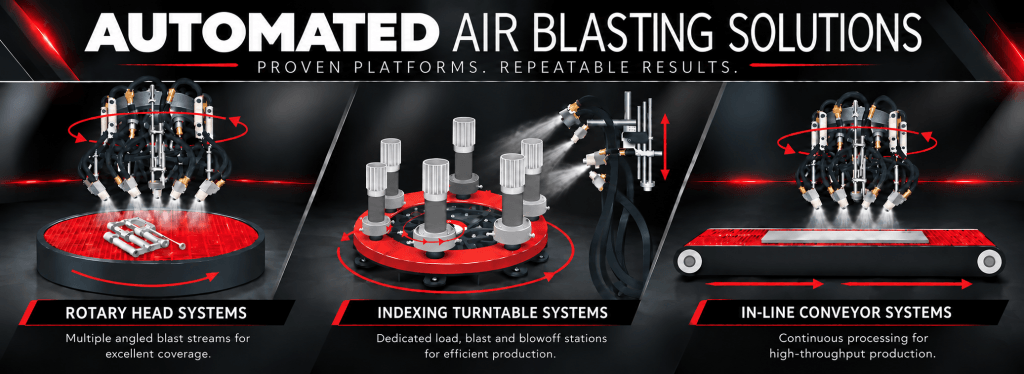
Empire’s automated air-blasting equipment can utilize several proven system concepts. Three core approaches—Rotary Head, Indexing Turntable, and In-Line Conveyor Systems—provide different methods of controlling the relationship between the blast stream and workpiece.
![Empire Rotary Head Illustration - resized]() Rotary Head Systems
Rotary Head Systems
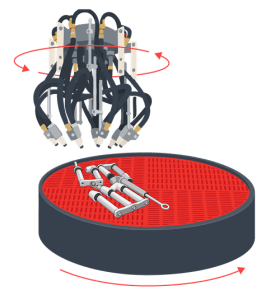
Rotary Head Air Blast Systems use multiple blast guns positioned around a rotating head to produce multiple angled blast streams. Parts are presented beneath the rotating head, providing broad and consistent blast coverage.
This approach can be incorporated into different machine configurations depending on the production requirements.
![Indexing Turntable Illustration - resized]() Indexing Turntable Systems
Indexing Turntable Systems
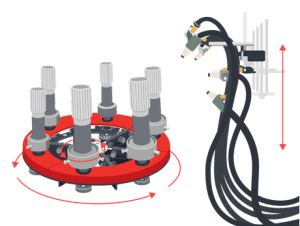
Indexing Turntable Air Blast Systems use a rotating table to move parts through dedicated processing positions. A system can incorporate separate stations for loading and unloading, blasting, and blowoff, allowing one operation to take place while another station is being serviced.
Individual fixtures can also rotate during the blast cycle to expose the required surfaces of the workpiece to the blast stream.
![In-Line Conveyor Illustration - resized]() In-Line Conveyor Systems
In-Line Conveyor Systems
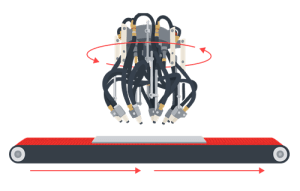
In-Line Conveyor Systems move parts continuously through the blasting process. Blast nozzles are positioned and controlled along the processing path to provide the required coverage as parts travel through the system.
This approach is particularly well suited to continuous production and can be integrated with upstream or downstream manufacturing operations.
Batch and cell machines can incorporate these and other automation concepts depending on the application. The machine configuration is ultimately determined by how the parts need to be handled and how the blast stream needs to interact with them.
Automation Does Not Necessarily Mean Robotics
Robotic air blasting is an important form of automation, but it is only one approach. Many applications can be automated effectively using mechanical methods of nozzle manipulation, part rotation, indexing, or continuous material handling. Other applications may benefit from the greater movement flexibility provided by a robotic system.
The appropriate solution depends on the part and process—not simply the desire to “automate.”
Standard Platforms vs. Custom Automation
Not every automated blast system needs to be designed completely from scratch. Empire’s proven automation concepts provide starting points that can be configured with different part-handling methods, nozzle arrangements, controls, media-delivery systems, recovery systems, and other options. For applications that fall outside established configurations, Empire can engineer custom systems around the specific production requirements. This allows the level and type of automation to be matched to the application rather than adding complexity the process doesn’t require.
Start With the Part, Then the Process
The first question when considering automation shouldn’t be, “How do we automate this?”
It should be:
“What does the blasting process need to accomplish?”
Part geometry, required surface finish, production rate, media, blast coverage, part handling, and upstream and downstream processes all influence the answer. Once those requirements are understood, Empire can determine how the part and blast nozzles should move—and which automation approach provides the most effective way to achieve that movement.
From batch processing and automated cells to indexing systems, Rotary Head equipment, continuous In-Line systems, robotic blasting, and fully custom equipment, the goal is the same: create a controlled, repeatable blasting process engineered around the customer’s production requirements.
Contact Us to discuss Automating your next Air Blast Project.