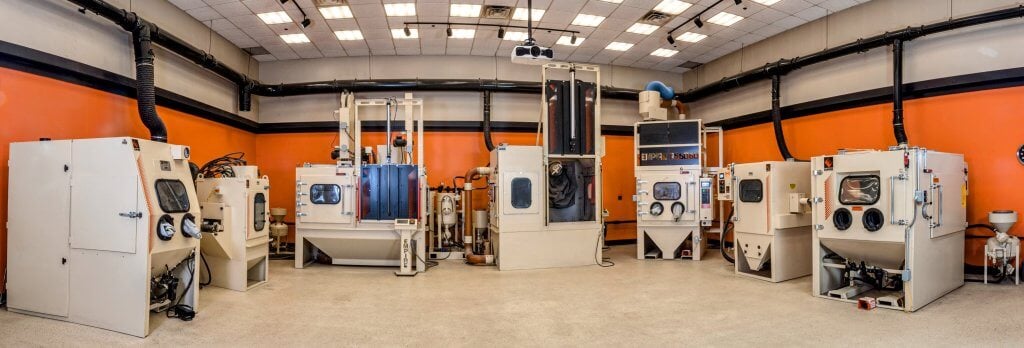
For manufacturers looking to optimize their blast finishing operations, validate new techniques, or even bring production back in-house, Empire’s Demonstration Lab plays a pivotal role. We sat down with members from the Empire team to explore how their in-house demonstration lab functions as a critical resource for their customers – providing invaluable data, physical proof, and peace of mind to customers navigating complex surface finishing challenges.
Interviewer: Can you describe what happens after someone submits a Request for Test to Empire for sample testing?
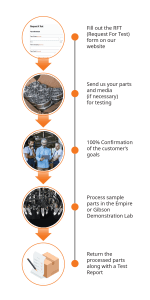
Empire: All Requests for Test are routed to the testing lab, assigned a test sample number, and every request is evaluated by the Lab Manager along with the local Sales Manager assigned to the project. Should we have any questions, comments, or suggestions, we will discuss them with the customer at this time prior to starting the parts testing process.
 Interviewer: And what happens after you have confirmation of the process scope?
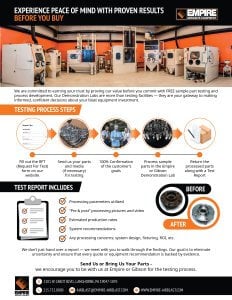
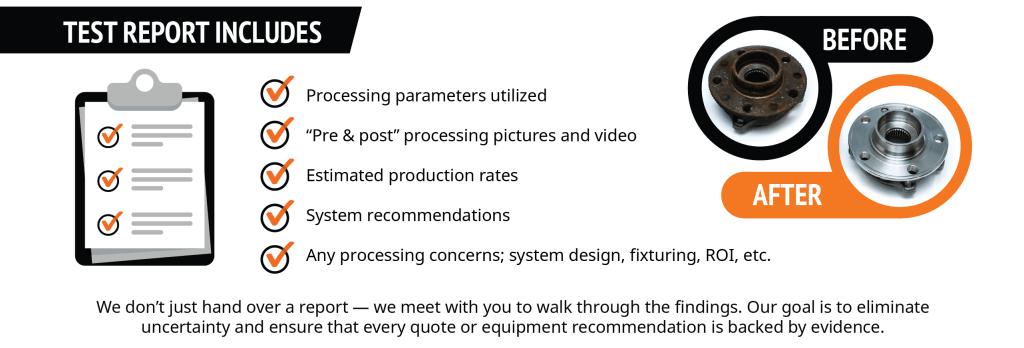
Empire: Once we have the completed request, the parts, and the media, we run the parts through the air blast or wheel blast machines in our lab according to the parameters they provided. The entire process is documented, complete with before-and-after photos, and compiled into a detailed report. That, along with the processed parts, goes back to the customer for evaluation.
At that point, the testing portion is complete unless further testing or follow-up is requested. We never make the final decision for the customer. Our goal in the lab is to give them enough data and physical proof to make an informed decision. We follow this same process for every application that comes through.
Interviewer: What kind of information is contained within the report you provide to the customer?
Empire: For example, we can measure surface profile using RA (roughness average), or any other standard depending on the region—JIS, ANSI, whatever the customer’s spec calls for. If it’s a peening application, and they call out intensity or coverage, we measure and report on that. If it’s a cleaning job, we can verify surface cleanliness and include production rate estimates.
Ultimately, the report is tailored to the customer’s desired outcome. It’s all part of the service we offer, and it’s all free of charge.
Interviewer: Where do suggestions or alternative approaches come into play—like comparing manual versus automated blasting?
Empire: Good question. We go to market through a network of distributors, and our regional managers oversee those relationships. So when we complete a test, all the communication and results go directly to the Regional Manager.
They, in turn, work with the distributor to present everything to the customer—the test report, processed parts, and their own insights. The regional manager understands our process; the distributor understands their customer. Together, they walk the customer through equipment options, production rates, purchasing, and scheduling.
Our test work becomes a foundational tool in the sales cycle.
Interviewer: Right—but in practical terms, what are you really providing?
Empire: More than anything, we’re trying to provide peace of mind and proof of concept. A customer might be issuing a PO for a custom-built machine, a one-off piece of equipment that’s never existed before. That’s a major investment. Our testing, our documentation, and the sample parts we return are proof that the equipment will perform as expected.
Even with something simple, the value comes from seeing the result firsthand. Maybe we already know we can do ten of those an hour, but instead of asking customers to take our word for it, we process the part, video the run, capture the parameters, and send it all back to them.
You don’t have to trust our word—you can evaluate the actual part. Our job is to provide a fair test and honest results. If the sample meets your standards, great. If not, at least you know.
Interviewer: That kind of transparency is huge.
Empire: Right. And I’m in a unique position here. I operate independently. I’m not tweaking results. I send what I get. If you want to visit and watch the test live, we welcome that. There’s no better sales tool than having a customer in the lab watching us hit their spec in real time.
That’s how we build trust—not just as a manufacturer, but as a surface finishing expert.
Interviewer: Let’s say a test comes in and the customer says, “We’re getting these parts processed overseas right now by a job shop. The results are decent, but our reject rate is too high, maybe 75–80% pass rate. We want to bring this process back in-house to improve efficiency and reduce the fail rate.”
Empire: That’s an ideal application for us. If they’re getting that many rejects, the finishing process is likely being done manually. We’d start by replicating their current process in a hand cabinet to understand the baseline. Once we can match that finish, we’d transition to automation—tuning the automated system to replicate the same result but at higher consistency and throughput.
Then we’d ask for more samples—say 10 parts—and run them through the automated process. We send those finished parts back and say, “Here’s the cycle time, here’s what you can expect from automation. Does this meet your standards?”
Interviewer: So you replicate the manual result first, then show them how automation improves it?
Empire: Exactly. We’re taking a manual process, often undefined and inconsistent, and creating a repeatable, efficient system. And when we present automation results, we always err on the conservative side, that way, we’ve got room to outperform expectations.
And because we did the lab work, we’re also the ones setting up and dialing in the equipment during the Factory Acceptance Test (FAT). We make sure the system performs exactly as it did in the lab, then we show customers how the solution can go faster or handle more parts. That usually results in a very satisfied customer.
Interviewer: Do you always run tests to demonstrate the differences between manual and automated processing?
Empire: Actually, no. We only do what the customer asks. If they request a manual trial, that’s what we deliver. If they ask for automation, we do automation. If they say, “We’re not sure,” then we might start with a manual process and build from there, but only if that’s appropriate.
Interviewer: What else is included in the report that customers get with sample part testing from Empire?
Empire: They get all kinds of great information confirming the type of equipment, the process approach, the media, production rates, and even specific finishes the customer wants. There’s a lot we might be validating—sometimes they want to do the same process across different material bases, so we’ll test to see what’s needed to get the same finish on all of them.
Every customer is different, so every report is unique as well. Sometimes we’re working with a junior engineer who just cares about production rate. Other times, a PhD might only care about the finish details. I could get a production worker focused on getting parts out on time, or a purchasing agent only caring about ROI and consumables.
Interviewer: So does the report help define their process, select the right equipment, or both?
Empire: Both. It really depends on what the customer is looking for. Some come asking us to try different medias to gather information to help make a choice. That information usually points them toward a particular platform that’s best suited for their needs. It’s about how they use that information moving forward.
No two customers have the same goals; therefore we’ve set up a system that provides consistency, transparency, and the data they need to make a decision – no matter what.
Interviewer: How do you run tests for a custom engineered one-off system that obviously is not in the testing lab?
Empire: We use a robot in the lab to simulate those processes we don’t have exact equipment for. We can simulate different speeds, motions, and automation. Our robot system even has a seventh-axis servo-driven system for coordinated motion.
If necessary, we’ve even torn apart and modified equipment to simulate customer needs. Empire’s approach is to do everything possible to simulate what we’ll build for you. The lab helps us ensure we can produce the finish and results needed.
Interviewer: What kind of parts or information do customers typically provide to you prior to testing?
Empire: Ideally, we get at least 6 to 12 identical pieces so we can experiment and dial in the process. The more detail we get regarding specifications for surface profile targets, bonding needs, peening requirements, etc. the better we can simulate their process. For instance, we might do “wet out” testing to improve bonding, measure micro-level surface roughness, or run peening trials that extend the fatigue life of aerospace or automotive parts. The more information they give us, the more value we can deliver.
Interviewer: Do customers always know what they want – or what’s possible?
Empire: It really varies. Some customers come with specs, process rates, and integration plans, but with startups or newer engineers, it’s often more exploratory. They might send one part and a list of questions just to get the conversation started. That’s where we step in as a technical partner, not just a test lab. We help educate their team on surface finishing and show them how certain processes will impact their parts and performance.
Interviewer: How are the finishing specifications provided to you defined?
Empire: Different countries and industries use different standards—Japanese Industrial Standards (JIS) differ from ANSI in North America, so we have to be fluent in all.
Understanding international standards is part of our job. If a customer from a Pacific Rim country is using JIS for fatigue performance, their expectations might differ from U.S. or European standards. We need to make sure the data and results we provide line up with their requirements—whether that’s technical specs or just presenting things in a way they understand.
Interviewer: Roughly what percentage of Empire’s sales go through your testing lab?
Empire: Any time we’re quoting an engineered system we prefer to do sample testing first. Before we cut steel or write up a purchase order, we want to make sure we understand the customer’s process and that we can deliver what we promise. The lab plays a key role in validating that.
The systems we’re building now are more sophisticated, so we’re moving from simply processing samples to becoming more of a technology partner. Customers are coming to us not just for parts processing, but for help solving surface finish processing challenges.
Interviewer: Are customers open to suggestions for alternative processes from what is originally presented to you for testing?
Empire: Sometimes customers are wide open to new process ideas. Typically speaking, anyone who is unhappy with their current method will listen to alternatives. It all comes down to customers gaining control back of their manufacturing processes. When you outsource, especially overseas, you lose visibility into the process.
The difference now is that customers are more involved. They want to understand the process. If they’re moving from manual to automated, they ask: how do I gauge process health? Can I monitor it in real time? Can I integrate the equipment into my Ethernet network for data tracking? So, it’s not just about the part result anymore, it’s about how to control, replicate, and scale that process.
Interviewer: That’s a big shift. What has changed the most over the last 15 years running Empire’s demonstration lab?
Empire: Fifteen years ago, sample testing was more straight forward—customers would send us a part and say, “Hey, process this. If it looks good, maybe we’ll buy a machine.” It was more transactional.
But, with reshoring and the push to bring manufacturing back to the U.S. – a trend that started even before COVID and has only grown since – we started seeing larger and more complex automation projects. Companies now want to bring production in-house and assume responsibility for tighter process control and improved consistency. They aren’t just looking for a machine, they are looking for a technology partner.
Interviewer: So, you consider reshoring to be the primary driver of this change?
Empire: Absolutely. When manufacturing moved overseas back in the ‘70s and ‘80s, it was all about chasing cheap labor. That made sense at the time, labor costs were lower, shipping was fast, and you could produce goods cheaply almost anywhere. But the trade-off was a loss in process control and introducing more waste overall due to lower efficiencies.
Nowadays, companies realize that chasing the lowest labor cost also meant compromising on quality and efficiency. So, with reshoring, they’re not just bringing work back, they’re rethinking how it’s done. That’s where automation fits in. Instead of relying on ten manual hand cabinets like they might have overseas, customers want a single automated system that gives them data, consistency, and control.
Interviewer: How does the Empire demonstration lab support that transition from offshoring to reshoring?
Empire: For customers reshoring production, understanding the finishing process becomes critical. Many rely on job shops to handle everything – blasting, anodizing, whatever – and just get finished parts back. But when they go back to those job shops to learn the process, they get shut down: “That’s proprietary.” That happens a lot, even in the U.S., and even more so overseas. So now they come to Empire saying, “We want to duplicate or reshore this process, but we don’t know how.”
On the flip side, we’ll also have customers who know exactly what they want. They’ll hand us a 100-page spec and say, “Build this and make sure it integrates with our current system.”
Interviewer: Does the customer with the 100-page spec get different a testing process vs. the one looking to define their process?
Empire: No, it’s important that we collect and track data consistently. For all intents-and-purposes, the customer we’re running tests for is anonymous. We’ll do a test, produce sample parts, develop our report, and move on to the next job. We may not even be looped in again until much later.
We make sure our work is detailed and thorough every time. That way, our team of people directly interacting with the customer has what they need to do their jobs well. We see our role in the lab as foundational, if our work is shaky, everything downstream—engineering, quoting, costing—could be shaky too.